Showing posts with label earth. Show all posts

Sunday, October 11, 2015

How to Calculate Distance to Horizon and Line of Sight

My first couple of questions after calculating curvature was well how far can I see? and how far does a building or object have to be before I can't see it anymore? So we need to figure out where the horizon is. More math! Yay!

You can download the calculator I made on my other post here.

Calculating Distance to Horizon

To calculate this we use the Pythagorean Theorem again but just solving for the distance instead of height. If you want the height equation click here.

So we start with this


If a² + b² = c² then for this example we get radius² + distance² = (height + radius)². So to solve for distance we just subtract radius from both sides and square the whole thing. Then we get distance = (r + h)² - r².

If we fill in the numbers we get distance = (3963 + .001136)² - 3963²   (To get miles we divide 6 feet by 5280 which equals .001136). This then becomes distance = 9.00393 = 3.00. So a person with their eye level at 6 feet will see the horizon at 3 miles.

If you wanted to use an approx. method just use 1.22 *h.

Line of Sight

So now we can use the same equation to find out how far away we can see an object. First you add the distance to horizon for each height together.  So if there are 2 people with an eye level of 6 feet we know they can each see 3 miles. 3 + 3 = 6. So this means they can see each other at a Maximum of 6 miles.
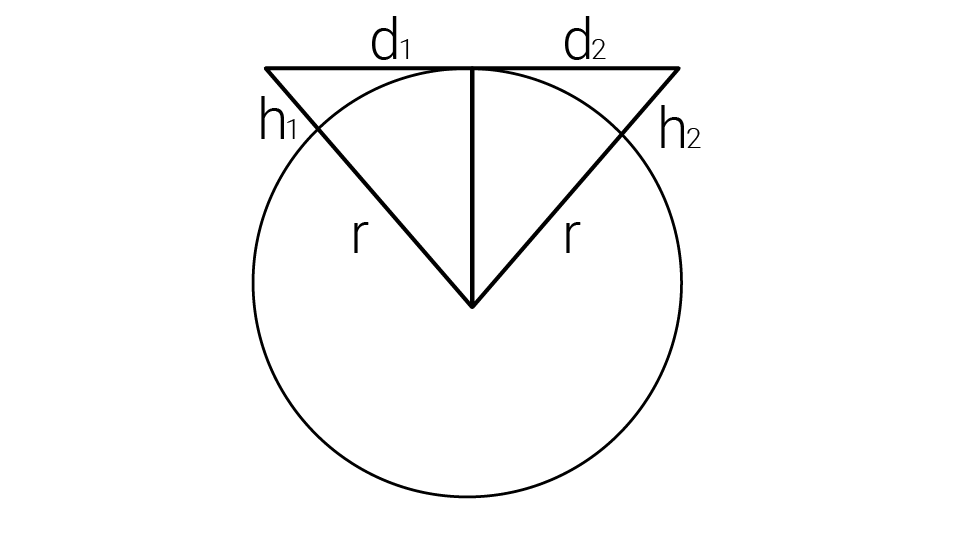

So if we know how far any height can be from the horizon we can determine how much is visible over the curve of the earth. We can take the Maximum distance and subtract the distance from object 1 to object 2. Then use the equation (r² + d²) - r = h or approximate formula h = (d/1.22)².

So let's try an example. If a person has an eye level of 6 feet and they are viewing a building 6 miles away. The building is 30 feet tall. We know a 6 foot eye level can see 3 miles to the horizon. Then we calculate and distance for a 30 foot building to be 6.7 miles. So the total possible distance for a person to see the tip of the building is 9.7 miles. Then subtract the distance between the person and the object. 9.7 - 6 = 3.7 miles. 

Now we can plug that in. (3963² + 3.7²- 3963² =  .001727. Multiply that by 5280 we get 9.12 feet. Using the approx. method (3.7/1.22)² = 9.2 feet.  Using either method we find that about 9 feet of the building is hidden below the horizon.

If you need to account for refraction there is an approximate method for that as well. Instead of 1.22 use 1.32. So the approximate refraction formula would be h = (d/1.32)².

If I didn't explain it well enough, Wikipedia does a great job here. 

Please do not hesitate to let me know if I made any mistakes. I would like all the information to be correct so any feedback is appreciated! Thank you!

How to Calculate Earth's Curvature

There are a few different definitions of curvature and several ways to calculate it. See curvature on Wikipedia.
You can download the calculator on my other post here
I also explain the math for distance to horizon and line of sight here.

I have found a few different methods that are pretty accurate up to around 100 miles. Then there is a more complex method that is accurate up to 3,963 miles which is the radius of the earth. So dust off your old geometry and trig books and let's begin!

Zetetic Astronomy

So the first method I need to mention is from Samuel Birley Rowbotham. He is mentioned frequently by the Flat Earth Society and his math is used in many flat earth videos. He believed the Earth was flat and published a book recording his experiments called Zetetic Astronomy, Earth Not a Globe. You can check it out here.

Rowbotham states that if the earth is 25,000 miles in circumference then the curvature would be 8 inches per mile.


To use his calculation you just square the mileage and multiply by 8. So if you use 3 miles it is 3 squared (9) and multiply by 8 (72), which is 6 feet. Therefore the Earth drops 6 feet in 3 miles.

Pythagorean Theorem

The next method uses the Pythagorean Theorem which says that the sum of the square of adjacent and opposite sides equals the square of the hypotenuse in a right triangle. a² + b² = c².
Earth Curvature Pythagorean Theorem
So we are trying to find the distance the Earth drops down per mile. So the equation would be radius² + distance² = (radius + drop)². If we are trying to find the drop we can change the equation to (r² + d²) - r = drop.

If the radius is 3,963 miles and the distance is 1 mile we can solve the equation. (3963² + 1²) - 3963 = drop.

Putting that into a calculator you get drop = .000126 mi. There are 5280 feet in a mile and 12 inches in a foot. So .000126 * 5280 * 12 = 7.98336 in.

Trigonometry

I might have to apologize to my math teacher for telling her I would never use this information. The next method is the hardest so I'm going to try my best to explain. The next method uses SIN COS and TAN. If you need a way better way of explaining it then go here.

So if you don't remember, to solve this we use SOH CAH TOA.

Sine = Opposite / Hypotenuse
Cosine = Adjacent / Hypotenuse
Tangent = Opposite / Adjacent


Using this information we can solve the curvature like this


In this example r = radius, d = distance, h = height/drop,  L = length, and a = angle. Based off of this we know we find the height by subtracting the length of the triangle from the radius.  How do we find that? back to the math!

We need to find the angle of a by using SIN(a) = d/r. Using the inverse of sine gives us the angle a = Sin-1(d/r). Using that we can use COS(a) = L/r changed to find L is COS(a) * r = L. Then we take L and subtract from the radius. Still with me?

The full equation is [r - (COS(SIN-1(d/r)) * r) = L] so let's plug that in. [3963 - ((COS(SIN-1(1/3963))) * 3963)]. If I typed this correctly it comes out to .000126168. Multiply that by 5280 and 12 we get 7.994 inches! We did it! 

I apologize if any of that was confusing, I tried my best!

Saturday, October 10, 2015

Earth Curvature Calculator

The calculator includes 3 different formulas for curvature and 3 for line of sight.
You can download the calculator by clicking the link here: Download

How To Use The Calculator


Earth Dimensions
Only enter numbers in the yellow boxes

The first step is to input Earth's circumference (in miles). The entire calculator refers to these numbers. So if you input earth's circumference to be 50,000 miles then the curvature and line of sight equations will change according to that.

I also included a conversion calculator. Use the yellow boxes to input miles, feet, inches, or kilometers.

Curvature Calculator
The next step is to input the distance for curvature. So if you input 1 mile it will change the rest of the equations to 1 mile. In the example you can see that the curvature is 8 inches for 1 mile using the Zetetic equation and 7.99 inches using the Pythagorean Theorem and Trigonometry Formula. All equations (besides Zetetic) are affected by the dimensions of the earth above.


The last part of the calculator is line of sight. Input an eye level and height of an object (in feet) and it will calculate the distance to the horizon for each height. (input height above sea level to be exact)

This will calculate the maximum distance you can be from the object before it disappears under the horizon. If you know the distance to the object it will calculate how much of the object is visible above the horizon and how much is hidden below it. So in the example, if your eye level is at 6 feet above sea level and you are 6 miles away from a 10 foot object above sea level then 4 Feet of the object is visible while 6 feet is hidden below the horizon.

It is important to include sea level in your calculation. If you are viewing a 80 foot building and it begins at 20 feet above sea level than use a height of 100 feet. Also be aware the amount that is calculated for visible and hidden considers the whole height as one object. (Example: If the amount visible for the total 100 foot height is 40 feet then you should only be seeing half of the 80 foot building).

I also included an approximate refraction formula if anyone needs it. I got the formula from this Wikipedia article.

If you would like to know more about the equations I use I explain it in my post here

Well that's it! Please feel free to point out and correct any mistakes I have made. That is how we all learn and I want this to be as useful as possible. Don't hesitate to let me know if you have any criticisms, questions, and/or suggestions. I hope this helps as you research, hypothesize, theorize, test and analyze! Thanks for reading!